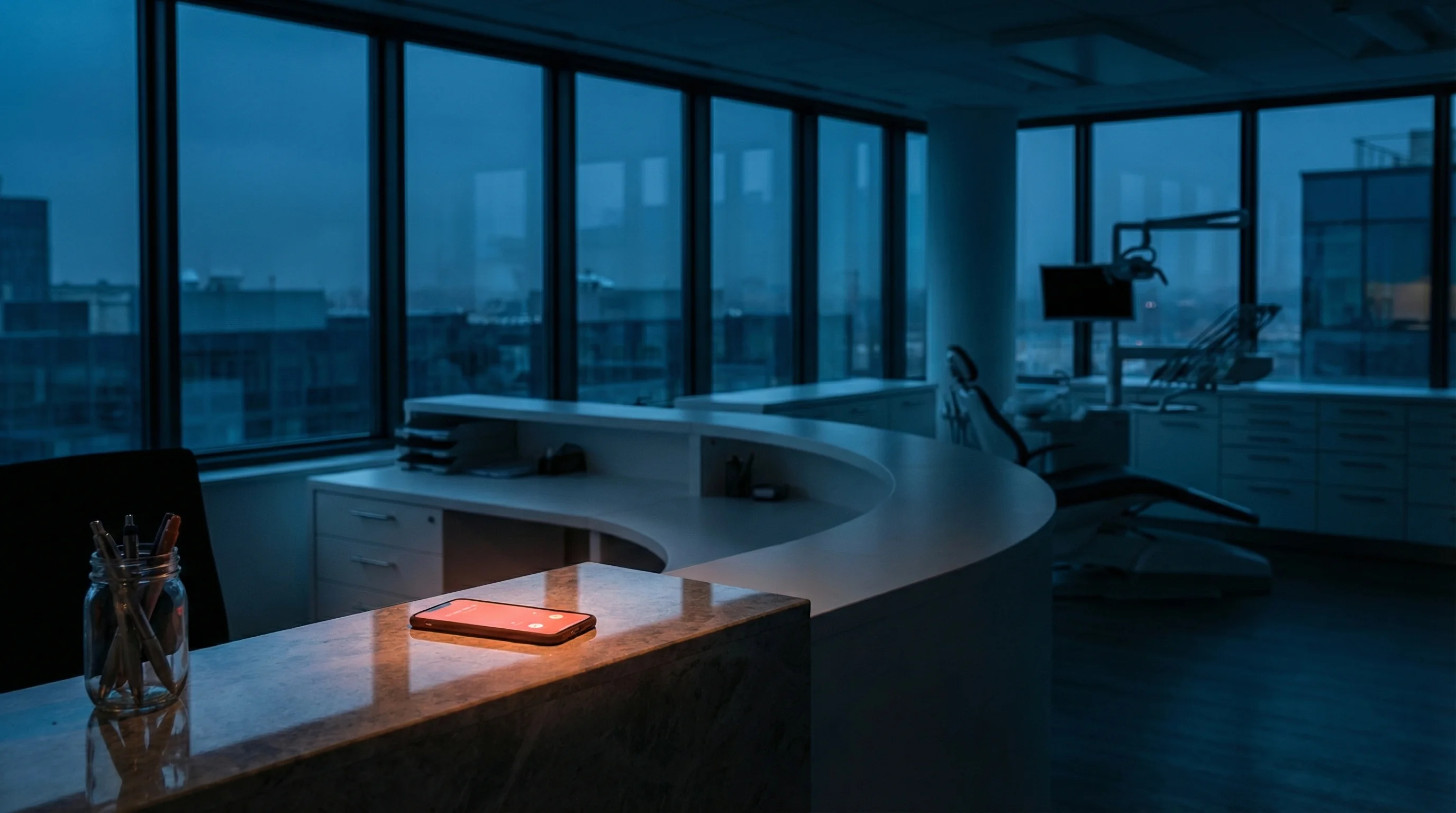
It is 7pm on a Tuesday. A patient has a throbbing toothache that started during dinner. They grab their phone and call your office.
Your voicemail picks up.
They hang up, Google "emergency dentist near me," and call the next practice on the list. That practice answers. The patient books a morning appointment, pays $800 for the procedure, and never thinks about your office again.
This happens every single day. 45% of patient calls to dental practices happen after 5pm. And 78% of callers hang up without leaving a voicemail.
That means for most practices, nearly half of all incoming calls are going unanswered, and the vast majority of those callers disappear forever.
The good news: you have options. Some are cheap and basic. Some are expensive and outdated. And one is changing how modern practices handle every call, day or night.
Here are five ways to handle after-hours calls at your dental practice, ranked from least effective to most.
1. Voicemail (The Default, and the Worst)
Most practices default to voicemail because it costs nothing. A recorded message plays, the patient is asked to leave their name and number, and someone from the front desk returns the call the next morning.
The problem is that patients hate voicemail. That 78% hang-up rate is not a guess. It is consistent across healthcare studies. People calling with a toothache at 7pm are not in the mood to leave a message and wait 14 hours for a callback.
Cost: Free.
Patient experience: Poor. The patient feels ignored, and there is zero interaction.
Appointment conversion: Very low. Most callers never leave a message. Of those who do, many have already booked elsewhere by the time you call back.
Voicemail works if you are the only practice in town. Otherwise, it is handing patients to your competition.
2. Answering Service (Expensive for What You Get)
A traditional answering service uses live operators who follow a script. When a patient calls after hours, a real person picks up, takes a message, and forwards it to your office or on-call dentist.
This sounds better than voicemail, and it is. A human voice is always more reassuring than a recorded message. But the experience falls apart quickly.
The operators do not know your schedule. They cannot book appointments. They cannot answer clinical questions or tell the patient what to do about their toothache tonight. All they can do is take a message and say someone will call back.
Cost: $200-$500/month, plus per-call fees that add up fast. Expect $0.75-$1.50 per call.
Patient experience: Better than voicemail. A human answers, which builds some trust. But the interaction is limited to "We will have someone call you back."
Appointment conversion: Low to moderate. The patient still has to wait for a callback, and there is no guarantee they will pick up when you call the next day.
3. Call Forwarding to Personal Cell (Works, But Burns You Out)
Some dentists forward after-hours calls to their personal cell phone or to the front desk manager's phone. This guarantees a real person answers who actually knows the practice.
For small practices where the dentist is deeply involved, this can work in the short term. You can answer questions, calm an anxious patient, and even book them into tomorrow's schedule.
The problem is sustainability. You become the answering service. Every call at 8pm, every Saturday morning ring, every holiday interruption. It works for a few months, then it leads to burnout.
Cost: Free in dollars. Expensive in quality of life.
Patient experience: Excellent when you answer. Terrible when you do not pick up because you are at dinner or asleep.
Appointment conversion: High when you answer. Zero when you miss the call.
This approach also creates a single point of failure. What happens when you are on vacation? Or sick? Or just need a night off?
4. Online Booking (Good Complement, Not a Complete Solution)
Adding an online booking widget to your website lets patients self-schedule appointments 24/7. When someone calls after hours and hears your voicemail, the message directs them to your website to book online.
This is a real improvement over plain voicemail. Patients who are motivated enough to visit your site can find an open slot and book it themselves. No waiting, no callbacks.
But it only works for a specific type of patient: someone who is comfortable navigating a booking system, knows exactly what they need, and is willing to switch from a phone call to a website.
The patient with a toothache at 7pm is not browsing your website looking for appointment slots. They want to talk to someone. They want reassurance. They want to know if this is an emergency or if it can wait until morning.
Cost: $50-$200/month for most booking platforms.
Patient experience: Good for routine scheduling. Poor for urgent situations or patients who prefer talking to a person.
Appointment conversion: Moderate. Captures the organized, tech-savvy patients. Misses the anxious, urgent, or older callers entirely.
5. AI Receptionist (The Modern Answer)
An AI receptionist is a voice AI system that answers your phone 24/7 with a natural, conversational voice. It sounds like a real person. It knows your practice, your schedule, your services, and your protocols.
When that patient calls at 7pm with a toothache, the AI receptionist picks up on the first ring. It asks about their symptoms, explains what they can do tonight to manage the pain, checks tomorrow's schedule, and books them into the first available morning slot. The patient hangs up feeling heard and taken care of.
Here is what sets it apart from every other option on this list: the AI does not just take a message. It resolves the call.
What an AI receptionist actually handles:
- Answers every call instantly, no hold times, no voicemail
- Books, reschedules, and cancels appointments in real time
- Answers common questions (insurance, hours, directions, what to expect)
- Triages urgent situations and escalates true emergencies to the on-call dentist
- Captures new patient information and adds it to your system
- Sends confirmation texts after booking
Cost: $150-$400/month depending on call volume. No per-call fees.
Patient experience: Excellent. Patients get immediate help, real answers, and a booked appointment in under two minutes.
Appointment conversion: Very high. There is no "we will call you back." The appointment is booked before the patient hangs up.
The Saturday Morning Scenario
Picture this: a new patient is moving to your area and calls your office on a Saturday morning to find a dentist for their family. They need cleanings for two adults and two kids.
With voicemail, they hear a message and move on. With an answering service, someone takes their name and says you will call Monday. By Monday, they have already booked with another practice.
With an AI receptionist, the system picks up, welcomes them, asks about their family's needs, checks your Monday and Tuesday schedule, books four appointments, sends confirmation texts, and collects their insurance information. When your front desk opens Monday morning, those four new patients are already on the books.
That single Saturday morning call could be worth $2,000+ in immediate cleanings and exams, and $40,000-$60,000 in lifetime patient value for the family.
How the Five Options Compare
| Solution | Monthly Cost | Patient Experience | Converts to Appointments |
|---|---|---|---|
| Voicemail | Free | Poor | Very Low |
| Answering Service | $200-$500+ | Moderate | Low |
| Call Forwarding | Free | Variable | Variable |
| Online Booking | $50-$200 | Good (limited) | Moderate |
| AI Receptionist | $150-$400 | Excellent | Very High |
The Real Cost of Missing After-Hours Calls
Let us do some quick math.
Say your practice misses 10 after-hours calls per week. That is conservative for most practices.
If 78% of those callers hang up without leaving a voicemail, that is roughly 8 patients per week who called you first but ended up somewhere else.
If even 3 of those would have booked an appointment worth $300-$500 on average, that is $900-$1,500 per week in lost revenue. Over a year, that is $46,000-$78,000 walking out your door.
Emergency calls are worth even more. A patient calling at 9pm with a cracked tooth or lost crown represents $400-$1,500 in immediate treatment value. These are high-urgency, high-value calls, and they are the most likely to happen outside business hours.
What to Look for in an AI Receptionist
If you are considering an AI receptionist for your dental practice, here is what matters:
Voice quality. The AI should sound natural and warm, not robotic. Patients should not feel like they are talking to a machine.
Calendar integration. It needs to connect directly to your scheduling system so it can book real appointments, not just promise callbacks.
Dental knowledge. It should understand common dental terms, procedures, insurance questions, and triage protocols. A generic AI assistant will not cut it.
Emergency escalation. True emergencies (uncontrolled bleeding, trauma, severe swelling) need to reach your on-call dentist immediately. The AI must recognize these and act fast.
HIPAA compliance. Any system handling patient information must be HIPAA compliant. This is non-negotiable.
Bilingual support. If your patient base includes Spanish speakers or other languages, the AI should handle those calls natively, not through awkward translation.
Start Capturing the Calls You Are Losing
Every dental practice loses patients after hours. The only question is how many.
If you want to see exactly how many calls your practice is missing and what those calls are worth, we will run a free analysis for you. No pitch, no pressure. Just the numbers.
Book a free after-hours call audit and find out what is walking out your door every night.